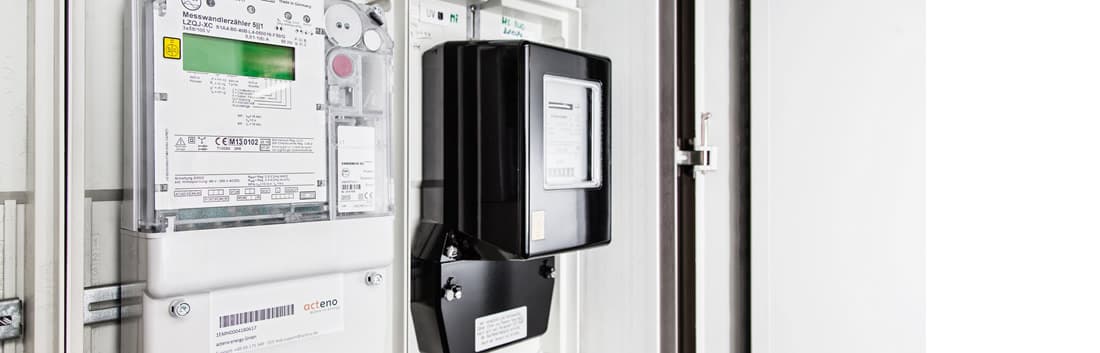
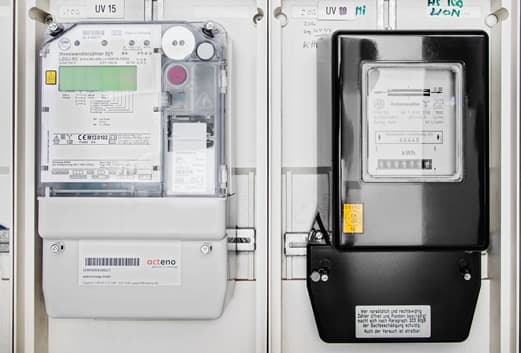
What is a load profile meter / rLM?
The rLM load profile measurement, short for "registering power measurement", is a procedure used for consumers with more than 100 MWh p.a. or generation facilities with more than 100 kWp installed capacity.
Unlike conventional meters, rLM meters continuously record actual electricity consumption/generation at defined time intervals. The interval in Germany is 15 minutes. For electricity, reactive energy in quadrants QI, QII, QIII and QIV is measured in addition to active energy. Time synchronisation at acteno is done via NTP or GPS depending on the application.
What is a smart metering system (iMS)
These metering devices are often referred to as "Smart Meters". They offer the ability to digitally display your consumption data and store this data in the device for up to two years. Meter readings are recorded at 15-minute intervals. Unlike mME devices, iMS devices can exchange data packages via a gateway and a data connection certified by the Federal Office for Information Security (BSI). These data packages may only be viewed and processed by certified and verified market participants, such as your grid operator or electricity supplier.
Currently, however, these metering systems are only intended for low-voltage customers with a maximum annual consumption of 100 MWh p.a. and for generation facilities with an installed capacity of 100 kWp.
What is a modern metering device (mME)
This type of metering device has a digital display and can internally archive your generation/consumption data for up to two years. However, they lack a data network connection, meaning they cannot send or receive data. acteno exclusively uses metering systems that can be continuously integrated via a data network and therefore does not offer modern metering devices.
What is SLP?
An SLP meter, short for standard load profile meter, is a device primarily used in locations with low energy demand such as private residences and small businesses. These meters do not record power data but only capture total consumption, which is read once annually. Consumption is estimated based on predefined standard load profiles, which form the basis for monthly advance payments. At the end of the year, billing is based on actual consumption.
The importance of standard load profiles lies in being able to better predict and understand fluctuations in energy consumption caused by temporal and weather-related influences. This ensures that sufficient energy is always available according to current demand. For efficient allocation and management, consumers are classified into different categories such as households, commercial or production facilities.
The use of an SLP meter is typically found at smaller consumption points where annual electricity consumption is below 100,000 kWh. If consumption exceeds this threshold, the installation of an RLM meter (registering power measurement) is required instead, which enables more detailed recording and analysis of energy consumption.
What is rLM?
RLM meters, which stand for registering power measurement, are mandatory at consumption points with annual consumption exceeding 100,000 kWh according to the Electricity Grid Access Ordinance (StromNZV). These meters are predominantly used in large companies and industry, as they continuously record energy consumption. The use of RLM meters thus also contributes to ensuring the stability of the electricity grid.
Regarding grid charges, RLM meters play an important role for companies. Unlike SLP meters, where grid charges are calculated based on energy consumption per kilowatt-hour plus a flat basic price, the costs for RLM meters consist of a working price per kilowatt-hour and a capacity price. The capacity price depends on the maximum power consumption (peak demand), which determines the load profile. Thus, a high peak demand can increase grid charges.
For generation facility operators, commercial and industrial customers with such meters, this means they receive monthly, precise invoices for their energy consumption or generation. This accuracy enables companies to optimise their load profile and thus achieve savings on grid charges. This procedure is also essential for energy procurement.