
What Is a Metering Concept?
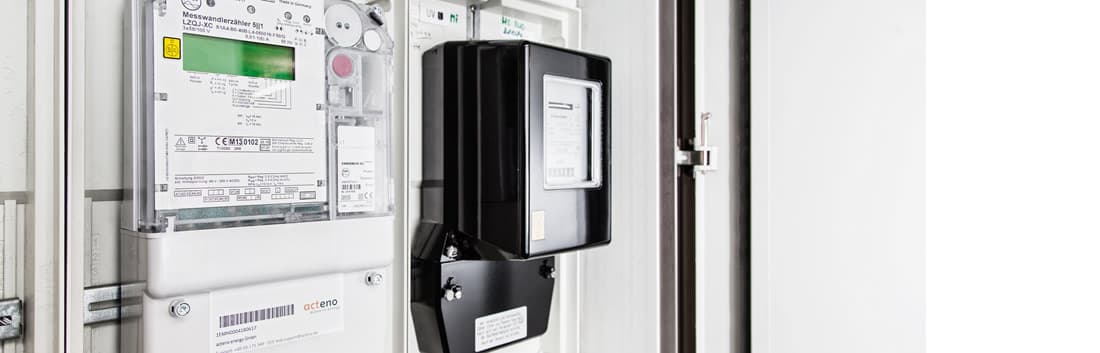
A metering concept defines the structured arrangement and configuration of all metering points at a grid connection point. It specifies which meters are installed at which location and how all energy flows – generation, consumption, feed-in, storage – are recorded correctly.
Metering concepts are needed above all where standardized solutions reach their limits: for generation plants, battery storage, charging infrastructure, heat pumps or combinations of these. They provide a clear overview of all energy flows at the site.
The decision on the appropriate metering concept lies with the plant operator or connection holder. In practice, it is coordinated jointly with the metering operator and the grid operator.
Why Does Renewable Energy Need Individual Metering Concepts?
Decentralized generation, storage, electric mobility, controllable loads and supply to third parties create complex energy flows that must be measured precisely. Without a suitable metering concept, you risk:
- Incorrect billing with the grid operator and the energy supplier
- Violations of regulatory requirements under German energy law (EEG, KWKG, EnWG)
- Missed optimization potential in self-consumption and load management
- Problems with commissioning and acceptance by the grid operator
A correctly planned metering concept ensures that all energy flows are recorded transparently, billed correctly and used optimally.
The Most Important Types of Metering Concept
Depending on the system type, capacity and usage scenario, different metering concepts are used:
Full Feed-in
With full feed-in, all of the energy generated is fed into the grid – there is no self-consumption. Typical for systems of 20 kWp or more where the operator receives the full remuneration under the EEG or KWKG.
- Bidirectional meters to record feed-in and grid consumption
- EEG/KWKG-compliant billing
- Suitable for pure feed-in systems without on-site consumption
Full Feed-in with Consumption
A variant of full feed-in at the shared grid connection point. All generation is fed into the grid, while separate consumption exists at the same connection point.
- Bidirectional metering required throughout
- Separate meters for generation and consumption
Surplus Feed-in
The typical concept for new systems of 30 kWp or more. The electricity generated is primarily self-consumed; only the surplus is fed into the grid. Self-consumption is the difference between generation (Z2) and feed-in (Z1).
- Grid consumption and feed-in recorded via Z1
- Self-consumption = Z2 (generation) minus Z1 (feed-in)
Surplus Feed-in with Generation Metering
An extended concept that can be combined with storage, charging infrastructure and additional generation plants. Complete generation metering enables a detailed allocation of the energy flows.
- Can be combined with storage, a wallbox and additional generation
- Requires a more complex metering concept with several metering points
Commercial-Accounting Transfer (§11 para. 2 EEG)
This concept can only be considered as an exception if a metering-based concept demonstrably cannot be implemented. Both meters (Z1 and Z2) must be designed as RLM meters (recording power measurement).
- Only permitted if the Full Feed-in concept is demonstrably impossible
- RLM meters mandatory for Z1 and Z2
Individual Special Solutions
Tailor-made metering concepts are developed for unconventional combinations of generation, storage, charging infrastructure, heat pumps and supply to third parties.
- Tailor-made for complex system configurations
- Coordination with the grid operator and, where applicable, the regulatory authority
Metering Concepts for Storage
Battery storage plays a central role in the energy transition and requires specific metering concepts. Integration depends on the intended use:
Generation-Side Storage
- Integration into wind and PV farms
- EEG-compliant metering concepts
- Optimization of the feed-in tariff
Grid-Distributed Storage
- Congestion management and grid relief
- Reactive energy compensation
- Primary control reserve
Industrial Storage
- Peak load capping (peak shaving)
- Self-consumption optimization
- Load management and flexibility marketing
- Exemption from double grid fees for 20 years
The Process: From Planning to Operation
Planning
Analysis of the system configuration, identification of all energy flows and selection of the appropriate metering concept. Generation plants, storage, charging infrastructure and consumption structures are taken into account.
Installation
Professional installation of all metering points in accordance with the agreed metering concept. Meters, instrument transformers and communication technology are installed according to the grid operator's specifications.
Coordination with the Grid Operator
The metering concept is submitted to the responsible grid operator for review and approval. Once coordination has been successfully completed, commissioning takes place.
Maintenance & Operation
Ongoing operation of the metering technology with regular maintenance, monitoring of calibration validity periods, market communication and data provision. If the system concept changes, the metering concept is adapted.