What Is Direct Marketing?
Direct marketing means that operators of renewable energy plants do not hand over the electricity they generate to the grid operator at the fixed feed-in tariff under the German Renewable Energy Sources Act (EEG), but actively sell it on the power exchange (EPEX SPOT). Direct marketing has been introduced step by step since the EEG 2012; with the EEG 2014, it became mandatory for all new plants with an installed capacity of 100 kWp or more.
The central instrument is the market premium model: plant operators receive the revenue from selling the electricity on the exchange plus a state market premium that makes up the difference between the market price and the so-called applicable value (“anzulegender Wert”, the technology-specific reference value from the EEG). This guarantees a minimum remuneration while at the same time creating incentives for market-oriented generation.
How Does the Market Premium Model Work?
In the market premium model, the plant operator's revenue is made up of two components:
Market value + market premium = guaranteed minimum revenue
Market premium = applicable value − monthly average value (specific to the energy source)
The applicable value is the technology-specific reference value that results from the EEG (for plants awarded in tenders: the award value).
The monthly average value is the average exchange electricity price for the respective energy source in the month in question.
In concrete terms, the plant operator receives two payment streams: the spot market price from the direct marketer, who sells the electricity on the exchange, and the market premium from the grid operator. If the exchange price achieved is above the monthly average value, the operator earns additional revenue beyond the applicable value.
Prerequisites for Direct Marketing
For a plant to take part in direct marketing, several technical and organizational prerequisites must be met:
Remote Controllability
The plant must be remotely controllable so that the direct marketer can adjust the feed-in power when required. This is usually done via a telecontrol system or a park controller.
Real-Time Metering Data
The metering technology must deliver real-time load profile data in 15-minute intervals. This data is the basis for generation forecasts and balancing group accounting.
Marktstammdatenregister
The plant must be registered in the Marktstammdatenregister (MaStR), the market master data register of the German Federal Network Agency (Bundesnetzagentur) – with correct details on location, capacity and form of marketing.
Contract with a Direct Marketer
A contract with an approved direct marketer is required. The plant is integrated into the marketer's virtual power plant in order to coordinate generation and marketing.
The Role of the Metering Operator
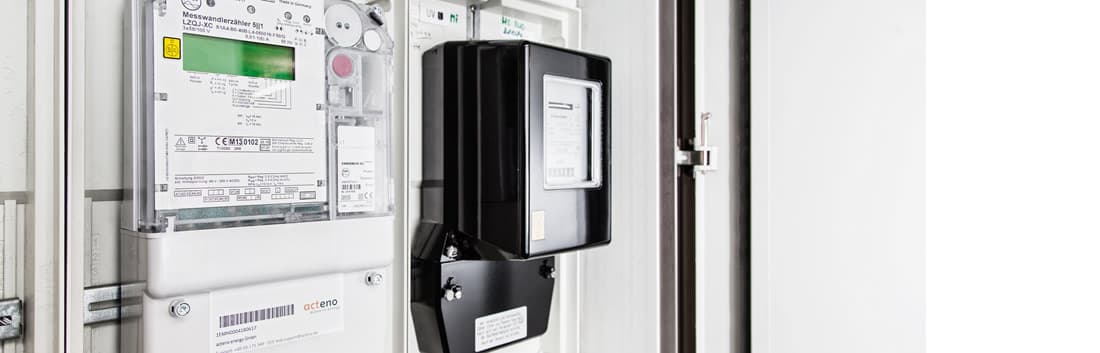
This is where acteno comes in: real-time metering data is the foundation of all successful direct marketing. Only when generation data is available precisely and in real time can direct marketers produce reliable forecasts. Better forecasts mean smaller deviations from the schedule – and thus lower balancing energy costs, which would otherwise reduce revenue.
acteno provides metering data via open interfaces:
As a competitive metering operator, acteno works independently of grid operators and energy suppliers. We support all voltage levels – from low voltage to extra-high voltage – and all plant types: wind, PV, biogas, storage and mixed parks.
Direct Marketing for Different Plant Types
Depending on the energy source, the requirements for metering technology and forecast quality differ. acteno develops suitable metering concepts for every plant type:
Wind Energy
Volatile feed-in requires high-frequency metering data for precise wind power forecasts. acteno delivers load profile data in real time.
Photovoltaics
Irradiation-dependent generation needs exact measured values as input for irradiance-based forecasting models.
Biogas
Flexibly controllable plants can generate additional revenue through demand-oriented operation. Precise metering data is the basis.
Storage
Battery storage systems in direct marketing require bidirectional metering of charging and discharging in real time.
Mixed Parks
Combined plants (e.g. wind + PV + storage) need complex metering concepts with separate recording for each generation unit.
What Happens After the EEG? (Post-EEG)
Once the 20-year EEG subsidy expires, the market premium no longer applies. The plant can continue to generate electricity, but has to hold its own entirely on the market. Plant operators have several options:
Power Purchase Agreement (PPA)
Long-term electricity supply contracts with offtakers provide planning certainty without the EEG subsidy. The price is agreed bilaterally.
Continued Direct Marketing
The electricity continues to be sold on the exchange – at the pure market price without a market premium. Economically attractive when exchange electricity prices are high.
Repowering
By replacing old components with more powerful technology, the plant can re-enter the EEG subsidy scheme.
acteno supports post-EEG plants with separate metering concepts that enable different marketing models at one site – for example when part of the generation is marketed via a PPA and another part via the exchange.