What is a Smart Meter?
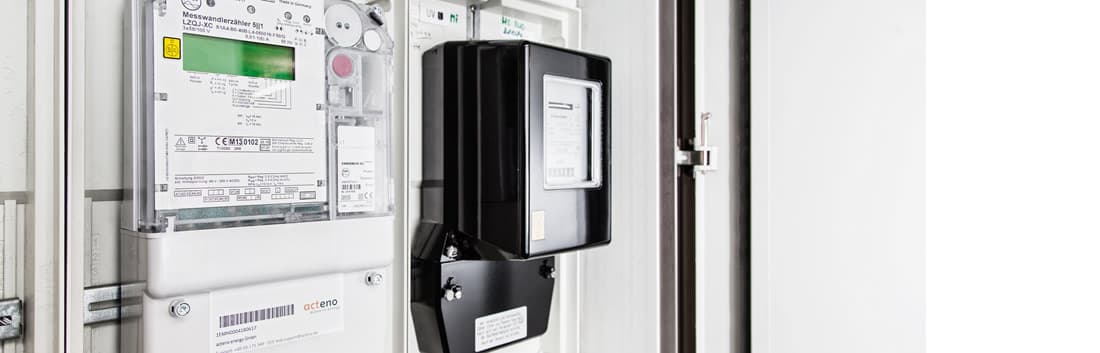
The term smart meter is often used colloquially for all digital electricity meters. Technically, however, it refers exclusively to a smart metering system (iMSys) – the combination of a digital meter and a Smart Meter Gateway (SMGW) certified by the German Federal Office for Information Security (BSI).
The gateway enables secure, encrypted communication between your meter and authorized market participants such as grid operators and energy suppliers. Without a gateway, the device is merely a modern metering device (mME) – a digital meter without a network connection that only stores data locally.
The Three Types of Metering Systems
Three types of metering systems are used in Germany. They differ fundamentally in functionality and intended use:
mME – Modern Metering Device
- Digital display with PIN-protected access
- Stores consumption data locally for up to 2 years
- No network connection – no remote reading possible
- acteno does not offer mME – we rely exclusively on connected systems
iMSys – Smart Metering System (Smart Meter)
- Digital meter + BSI-certified Smart Meter Gateway
- Recording at 15-minute intervals, storage for at least 2 years
- Secure data transmission to certified market participants
- For low voltage: consumption up to 100 MWh/a or generation below 100 kWp
rLM – Load Profile Meter (Registering Power Measurement)
- For consumers of 100 MWh/a or more, or producers of 100 kWp or more
- Continuous recording at 15-minute intervals
- Measurement of active and reactive energy in quadrants QI–QIV
- Time synchronization via NTP or GPS
Smart Meter Rollout in Germany
The German Metering Point Operation Act (MsbG) of 2016 laid the foundation for the digitalization of the energy transition and the comprehensive installation of smart metering systems. With the amendment of the MsbG in May 2023, the rollout was significantly accelerated: the requirements that had applied until then (three mutually independent BSI-certified gateways) were simplified and binding installation deadlines were set.
Mandatory installation applies in particular to:
- Consumers with an annual consumption of more than 6,000 kWh
- Operators of generation plants with an installed capacity of 7 kWp or more
- Controllable consumption devices (e.g. heat pumps, wallboxes)
Since the liberalization of metering in 2011, all customers have had the right to choose their metering operator freely – regardless of whether installation is voluntary or mandatory.
Data Security and Privacy
The security of metering data is at the heart of the smart meter rollout. The Smart Meter Gateway is the only IT system in the energy market that has to undergo BSI certification according to Common Criteria. This certification ensures:
- End-to-end encryption of all communication channels
- Only certified and verified market participants are given access to data
- Technical separation between metering operator, grid operator and supplier
- Regular security audits and updates by the gateway administrator
acteno energy acts as an independent metering operator without conflicts of interest – your data is not tied to grid or sales interests.
Smart Meter and Energy Management
A smart meter on its own delivers data – the real added value only comes from intelligent energy management. This is where acteno comes in: we turn metering data into actionable insights for your company.
Optimization & Control
- Real-time load management and peak load capping (peak shaving)
- Self-consumption optimization for PV and storage systems
- ESG reporting based on real consumption data
- Forecasting and balancing group management
Integration & Interfaces
- Industrial protocols: OPC-UA, ModBus, MQTT, BACNET, KNX
- Market communication: MSCONS, AS4
- Data export: REST API, Excel, CSV, XML
- Connection to existing ERP and BMS systems